Tree Care
Why You Should Never Top Your Trees
Tree topping is one of the most harmful things you can do to a tree. We explain why topping causes long-term damage and what alternatives exist.
Tree topping — the practice of cutting back large branches to stubs or lateral branches too small to assume the role of a terminal leader — is one of the most damaging things you can do to a tree. Despite this, it remains common, often performed by well-meaning homeowners or unqualified contractors who present it as a way to reduce tree size or manage storm risk.
Why Topping Is Harmful
Topping removes a large percentage of the tree's leaf-bearing crown, which is its food factory. The tree is forced to rapidly produce new shoots (called epicormic growth or water sprouts) from dormant buds near the cut surfaces. This response is a stress reaction — the tree is desperately trying to replace its lost energy production capacity.
The resulting growth is weakly attached to the outer layers of the remaining branch stubs. Unlike natural branches that develop strong structural connections over years, water sprouts are anchored only in surface wood. As they grow larger and heavier, they become increasingly prone to failure — often at the exact point the tree was topped. Ironically, topping creates more hazardous conditions than it was supposed to prevent.
Additional Consequences
Beyond structural weakness, topping leads to: large open wounds that invite decay and disease, bark exposure to sudden sunlight causing sunscald, dramatically reduced property value (studies show topped trees reduce property values by 10 to 20 percent), increased long-term maintenance costs from repeated sprout management, and potential tree death in species that cannot tolerate severe pruning.
Better Alternatives
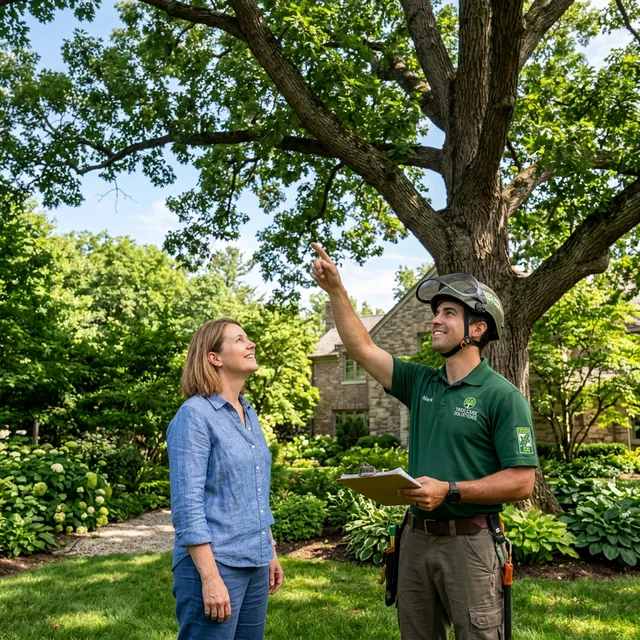
If you need to reduce a tree's size, a certified arborist can perform crown reduction pruning — a technique that reduces height and spread by cutting branches back to appropriate lateral branches that are large enough to assume the lead role. This maintains the tree's natural form, structural integrity, and long-term health. For trees that have outgrown their space entirely, removal and replacement with an appropriately sized species is often the better long-term investment.
If a contractor recommends topping your tree, we encourage you to get a second opinion from an ISA Certified Arborist.
Need help with this issue on your property? Our ISA Certified Arborists can evaluate your situation and recommend the best course of action.