
Commercial
Understanding Tree Risk Assessments for Commercial Properties
Commercial property managers have a duty to manage tree-related risks. Learn about TRAQ assessments and proactive tree management.
If you manage a commercial property, the trees on your site are both assets and potential liabilities. A mature tree enhances curb appeal and tenant satisfaction, but a tree that fails and damages a vehicle, building, or injures a person creates significant legal and financial exposure. Tree risk assessments are the professional standard for identifying and managing these risks before they become incidents.
What Is a Tree Risk Assessment?
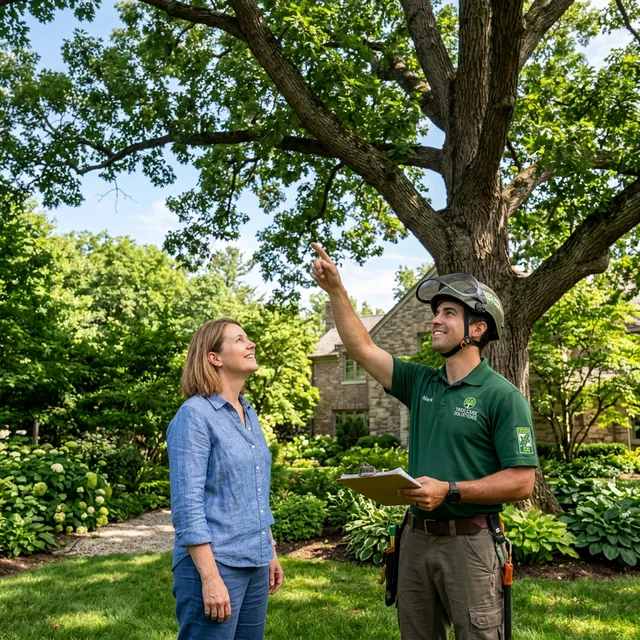
A tree risk assessment is a systematic evaluation of a tree's likelihood of failure and the potential consequences if it does fail. The ISA (International Society of Arboriculture) developed the Tree Risk Assessment Qualification (TRAQ) as the industry standard methodology. TRAQ-qualified arborists evaluate three key components: the likelihood of a tree or branch failing, the likelihood that a failed tree or branch will strike a target (person, vehicle, building), and the severity of the consequences if a strike occurs.
When Are Assessments Needed?
Commercial property managers should consider tree risk assessments in several situations: as part of an annual or biennial property maintenance program, after significant storm events, when tenants or visitors report concerns about specific trees, before and during construction projects near existing trees, when trees show visible signs of decline or structural defects, and as part of due diligence during property transactions.
The Business Case for Proactive Assessment
Beyond reducing liability, tree risk assessments make good business sense. They allow you to budget for tree work over time rather than reacting to emergencies. They document your due diligence in managing known hazards — critical information if a claim ever arises. They can identify trees that need relatively minor corrective pruning now, preventing the need for costly removal later. And they help preserve healthy, valuable trees by directing resources where they're needed most.
What Happens After an Assessment?
After completing an assessment, the arborist provides a written report categorizing each tree's risk level (low, moderate, high, or extreme) and recommending specific mitigation measures. Common recommendations include monitoring, pruning to remove defective branches, cabling and bracing to support weak structures, root zone management, or removal when a tree cannot be made reasonably safe.
Our TRAQ-qualified arborists provide comprehensive tree risk assessments for commercial properties throughout the Portland-Vancouver metro area. Contact us to schedule a property evaluation.
Need help with this issue on your property? Our ISA Certified Arborists can evaluate your situation and recommend the best course of action.